
Han, J.S. Acupuncture and endorphins. Neuroscience Letters, 361 (2004), 258-261.
https://pubmed.ncbi.nlm.nih.gov/15135942/
Key points:
Naloxone, an opioid receptor antagonist, used as a pharmacological tool for the study for electroacupuncture (EA) mechanism.
Acupuncture-induced analgesia can be blocked by naloxone in humans and mice
D.J. Mayer, D.D. Price, A. Rafii, Antagonism of acupuncture analgesia in man by the narcotic antagonist naloxone, Brain Res. 121 (1977) 368 – 372.
B. Pomeranz, D. Chiu, Naloxone blocks acupuncture analgesia and causes hyperalgesia: endorphin is implicated, Life Sci. 19 (1976) 1757–1762.
Greater dosage of naloxone required to reverse higher-frequency EA analgesia.
IC50 of naloxone for 2, 15, 100 Hz EA = 0.5, 1.0, 20 mg/kg, respectively.
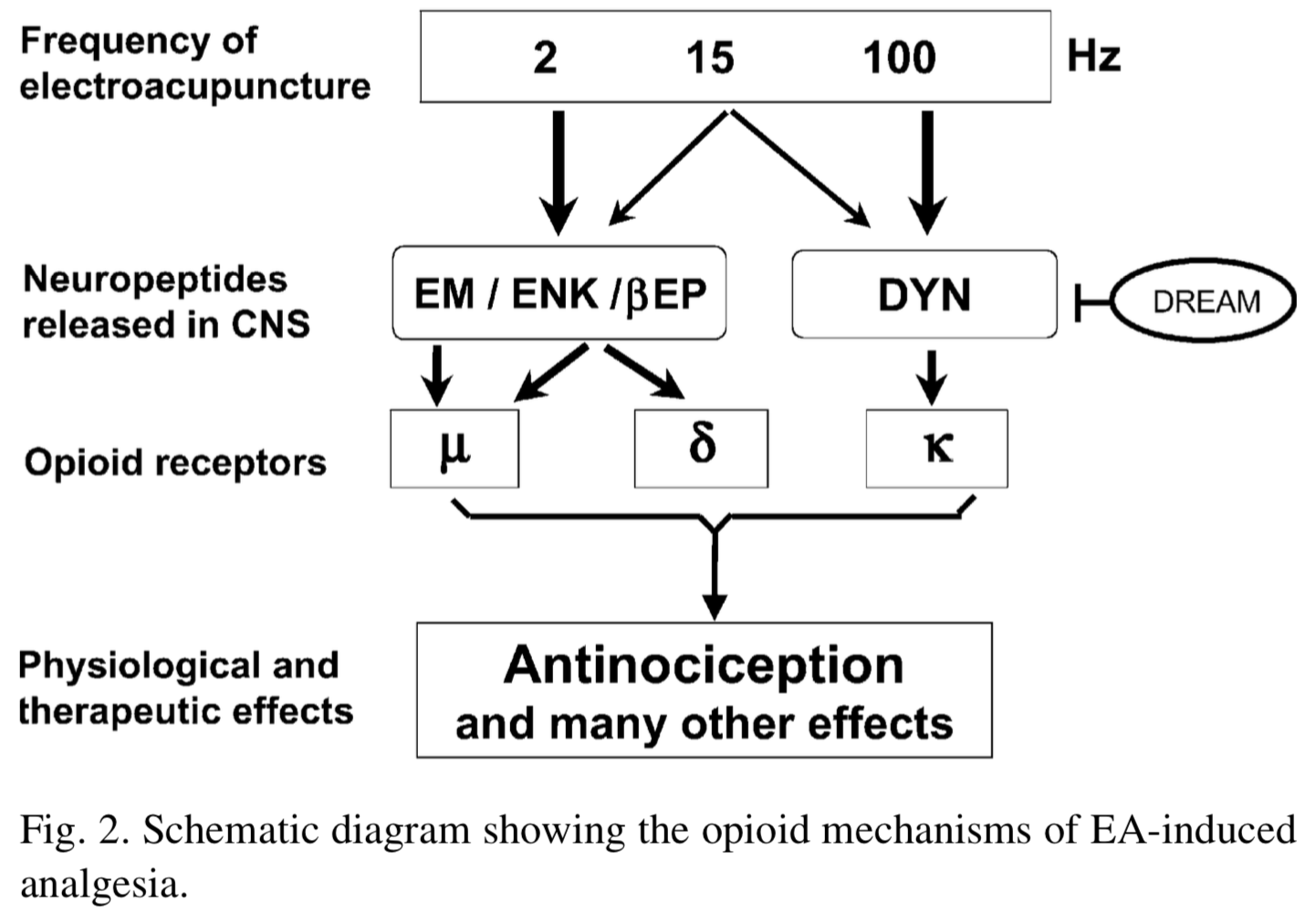
Different EA frequencies produce different endorphins:
H. Fei, G.X. Xie, J.S. Han, Low and high frequency electroacupunc- ture stimulation release met-enkephalin and dynorphin A in rat spinal cord, Sci. Bull. China 32 (1987) 1496–1501.
Rats given EA using radiant heat-induced tail flick latency (TFL) as endpoint of nociception. Subarachnoid space of spinal cord perfused, perfusate collected in 30 min intervals before/during EA stimulation. Radioimmunoassay measured contents of met-enkephalin and dynorphin A/B.
2 Hz produced 7-fold increase in met-enkephalin but not dynorphin A.
100 Hz produced 2 fold increase in dynorphin A but not met-enkephalin.
15 Hz produced partial activation of both enkephalins and dynorphins.
Control: no increase in endogenous opioid release in non-responder rats that did not show any increase in TFL after EA stimulation.
Release of Beta-endorphin and endomorphin also stimulable by 2 Hz EA, only dynorphin responds to high-frequency EA stimulation.
Dynorphin synthesis is regulated by DREAM (down-stream regulatory element with antagonistic modulation), constitutive transcriptional suppressor of prodynorphine gene expression. DREAM-KO experiment in animal models show dynorphins to be analgesic.
H.Y.M.Cheng,G.M.Pitcher,S.R.Laviolette,I.Q.Whishaw,K.I.Tong, L.K. Kocheritz, T. Wada, N.A. Joza, M. Crackower, J. Goncalves, I. Sarosi, J.R. Woodgette, A.J. Oliveira-dos-Santos, M. Ikura, D. van der Kooy, M.W. Salter, J.M. Penninger, DREAM is a critical transcrip- tional repressor for pain modulation, Cell 108 (2002) 31–43.
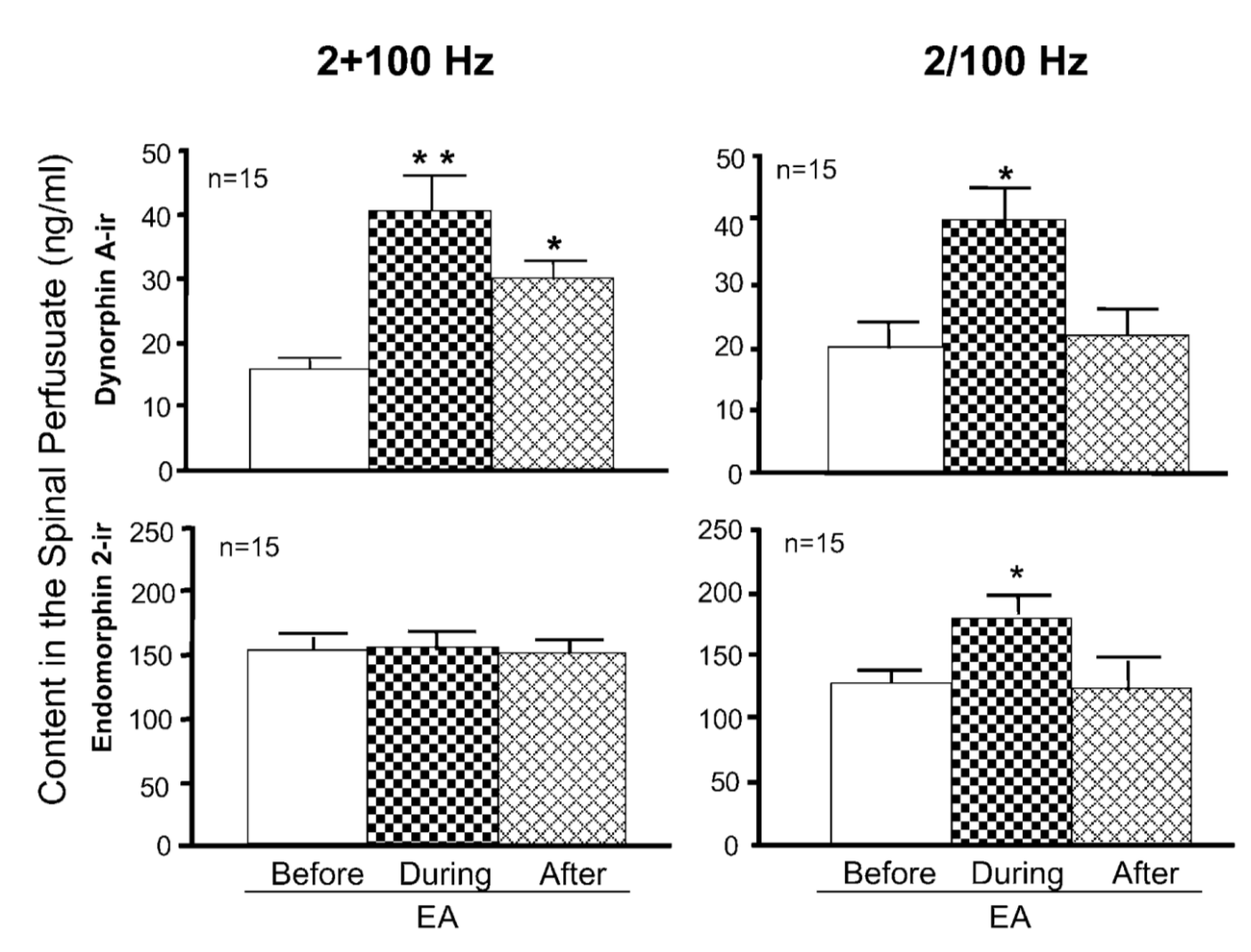
The brain cannot differentiate 2 Hz and 100 Hz in simultaneous stimulation (only releases dynorphin). For maximum therapeutic effect (maximal release of analgesic neuropeptide cocktail), switching between 2 Hz and 100 Hz works best (animal models).
Y. Wang, Y. Zhang, W. Wang, Y. Cao, J.S. Han, New evidence for synergistic analgesia produced by endomorphin and dynorphin, Chin. J. Pain Med. 8 (2002) 118–119.
In humans: the alternative node stimulation reduced post-operative morphine requirement by 53%, whereas constant low (2 Hz) or high (100 Hz) stimulation produced a 32% or 35% decrease, respectively.
M.A. Hamza, P.F. White, H.E. Ahmed, E.A. Ghoname, Effect of the frequency of transcutaneous electrical nerve stimulation on the postoperative opioid analgesic requirement and recovery profile, Anesthesiology 91 (1999) 1232–1238.
Similar results obtained in clinical studies on low back pain and diabetic neuropathic pain.
E.A. Ghoname, W.F. Craig, P.F. White, H.E. Ahmed, M.A. Hamza, B.N. Henderson, N.M. Gajraj, P.J. Huber, R.J. Gatchel, Percutaneous electrical nerve stimulation for low back pain: a randomized crossover study, J. Am. Med. Assoc. 281 (1999) 818–823.
M.A. Hamza, P.F. White, W.F. Craig, E.S. Ghoname, H.E. Ahmed, T.J. Proctor, C.E. Noe, A.S. Vakharia, N. Gajraj, Percutaneous electrical nerve stimulation: a novel analgesic therapy for diabetic neuropathic pain, Diabet. Care 23 (2000) 365 – 370.